

On paper, most Bluetooth speakers shouldn’t sound as big as they do. The drivers are small, the cabinets are cramped with batteries and electronics, and yet they still manage punchy bass drops and crisp vocals. The trick is that modern designs squeeze every advantage from physics and processing: tuned boxes, clever ways of “cheating” low end, and DSP that constantly shapes what the drivers are asked to do.
According to the audio experts at SoundGuys, because portable speakers are physically small, they cannot naturally produce deep bass (low frequencies); therefore, they use a DSP to “cheat” physics by boosting bass frequencies at low volumes and employing passive radiators—unpowered diaphragms that vibrate in sympathy with the active driver—to move more air and reinforce the low end .
Simultaneously, high-frequency treble is handled by smaller, stiffer drivers called tweeters, which are capable of vibrating thousands of times per second to create the crisp, directional sound waves we perceive as high notes. This entire process is managed by an active crossover that electronically splits the incoming digital signal, ensuring the high-energy bass waves are sent to the woofer and the delicate, fast-moving treble signals are sent to the tweeter, preventing distortion and protecting the drivers
Drivers, Enclosures, and the Limits of Size
The physical driver—a dynamic cone with voice coil and magnet—is still what actually moves air. Low frequencies need relatively large excursions and cone areas, while high frequencies demand low‑mass diaphragms that can change direction very quickly. Because most Bluetooth speakers use 1–3.5 inch full‑range or mid‑bass drivers, they’re already fighting an uphill battle to move enough air for convincing bass.
Enclosure design is how they claw some of that back. Sealed boxes give tight, controlled low end; tuned ports or carefully calculated internal volumes can lift output around a chosen bass region at the cost of some extension. In very small cabinets there often isn’t room for a proper port, which is where passive radiators come in.
Passive Radiators and How Small Boxes Fake Bass
A passive radiator is essentially a cone without a motor: it has no voice coil or magnet and simply moves in response to pressure changes from the active driver inside the box. By choosing its mass and suspension carefully, designers tune it like a virtual port, so it resonates and reinforces a band of low frequencies that the small main driver would struggle to produce on its own.
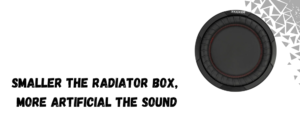
This approach lets manufacturers get deeper, louder bass from compact enclosures without long folded ports (which take up space) or the chuffing noise that can come from high air velocities at the port mouth. It doesn’t rewrite the laws of physics—the very lowest notes still need air and excursion—but it fills in the “weight” region where listeners feel kick drums and bass guitar.
Class‑D Amplifiers, DSP, and Shaping the Frequency Balance
Electronics do the rest of the heavy lifting. Almost all modern Bluetooth speakers use highly efficient Class‑D amplifiers, which can deliver useful power over the 20 Hz–20 kHz band without turning batteries into heaters. That efficiency is what lets a small pack run a pair of drivers at credible levels for hours.
Ahead of the amp, onboard DSP continuously shapes the spectrum. It can:
- Apply dynamic EQ that boosts bass at moderate levels but dials it back as you turn up, protecting the drivers from over‑excursion.
- Flatten or contour the mid and treble response to sound more neutral or more “excited,” depending on the brand’s voicing target.
- Act as a crossover in multi‑driver designs, sending lows to a woofer and highs to a tweeter or super‑tweeter, improving clarity and power handling without bulky passive components.
In practice, this means the same hardware can sound lean or bass‑heavy just by swapping presets; what you hear as “character” is often a DSP curve managing both bass and treble around the drivers’ safe operating envelope.
Product Spotlights
Rockville HD5 – Powered Bookshelf Speakers
Rockville HD5 is a 2-speaker powered bookshelf/home-theater system with a built-in Class D amplifier delivering 150 W RMS (600 W peak) to a 5″ woofer and 0.75″ tweeter in each cabinet, designed for loud but refined stereo playback in living rooms, bedrooms, or desktop setups.
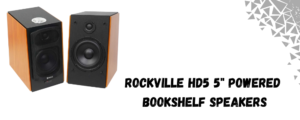
It offers Bluetooth 4.2 with roughly 33 ft range, USB playback, AUX/optical/coaxial inputs (varies by listing), onboard DSP with EQ presets (e.g., Music, Movie, News, 3D), and remote control, making it well suited for TV audio, music streaming, and nearfield listening rather than mobile PA use. MDF enclosures, slanted front design, LED status indication, and auto-switchable power supply round it out as an “audiophile-leaning” consumer speaker system focused on fidelity and convenience in a fixed location.
Key points – Rockville HD5
- Powered stereo bookshelf system, 5″ woofer + 0.75″ tweeter per speaker, 150 W RMS / 600 W peak total.
- Bluetooth 4.2, USB, AUX and digital inputs with onboard DSP EQ presets and included remote.
- Best for home listening (music, TV, desktop) where you want hi-fi stereo rather than PA-style projection.
5 Core Portable Bluetooth Party Speaker (PA/Karaoke Boombox)
The 5Core portable Bluetooth party speaker is an active DJ/party PA with an 8″ or 15″ driver (series variants) plus a super bullet tweeter, built-in sub section, and trolley-style cabinet for mobile use at parties, outdoor events, or karaoke nights. It includes 2 wireless microphones (some bundles list 2–4 mics), Bluetooth 5.0 streaming, and multiple inputs—USB, TF card, guitar, mic, and AUX—along with rear EQ controls for bass, treble, master volume, mic echo and guitar level, making it a self-contained sound system for singers, presenters, and casual DJs.
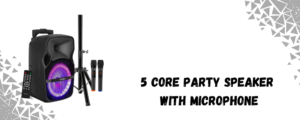
A rechargeable battery (e.g., 7.4V/2200 mAh or larger on 15″ version) gives roughly 3–7 hours of playtime, while the trolley handle, wheels, LED party lights, included tripod stand, and remote make it clearly oriented toward events rather than stationary hi-fi listening.
Key points – 5Core Party Speaker
- Active portable PA with 8″ or 15″ woofer + bullet tweeter, 25–80 W RMS (250–800 W PMPO depending on size) and built-in rechargeable battery.
- Bluetooth 5.0, USB/TF, guitar, mic, AUX inputs, 2 wireless mics included, rear-panel EQ and echo, LED lighting, trolley + wheels, stand included in many bundles.
- Best for karaoke, parties, outdoor events, speeches and mobile PA, where battery power and wireless mics matter more than pure stereo imaging.
How It All Adds Up to Bass and Treble You Believe
Put together, these elements explain why a hand‑sized cylinder can feel surprisingly full‑range. The driver and box establish the basic acoustic limits; passive radiators or tuned ports stretch the apparent low end; Class‑D amps provide clean wattage from a small battery; and DSP constantly massages the waveform so bass feels present without destroying the driver, while treble stays bright enough to cut through background noise.
The trade‑offs are still there—very compact speakers can’t move as much air as a real sub, and aggressive DSP can only push physics so far—but smart engineering means most listeners get a convincing sense of bass and treble in a package that fits in a bag. Understanding that chain makes it easier to read spec sheets and demos for what they are: different choices in how to divide limited size, power, and processing budget between low‑end weight and top‑end detail.
Here you can also find amazing drum thrones; alternatively, browse our page to find the best keyboard bench, audio mixers, drum mics, piano bench, keyboard stand, speakers, party speakers, and more.